Our machines

Takes the operator's hand out of the equation.

Sift, pressurize, purge. The part of the process that varies most with the day and the mood of whoever's doing it is the part the machine standardizes. Here's each one in full: every angle, how to use it, what the manufacturer specifies, and which model is yours.

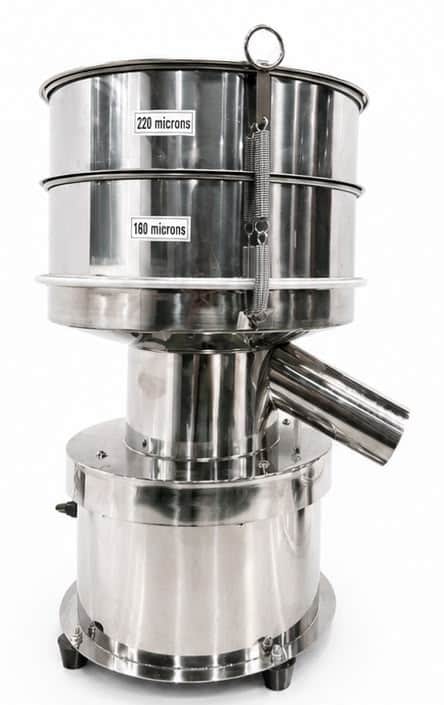
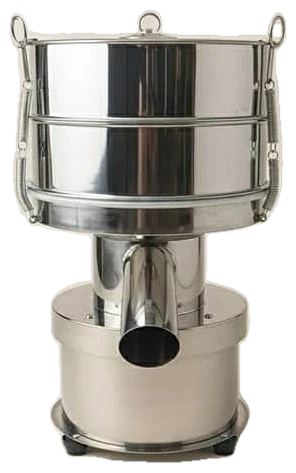
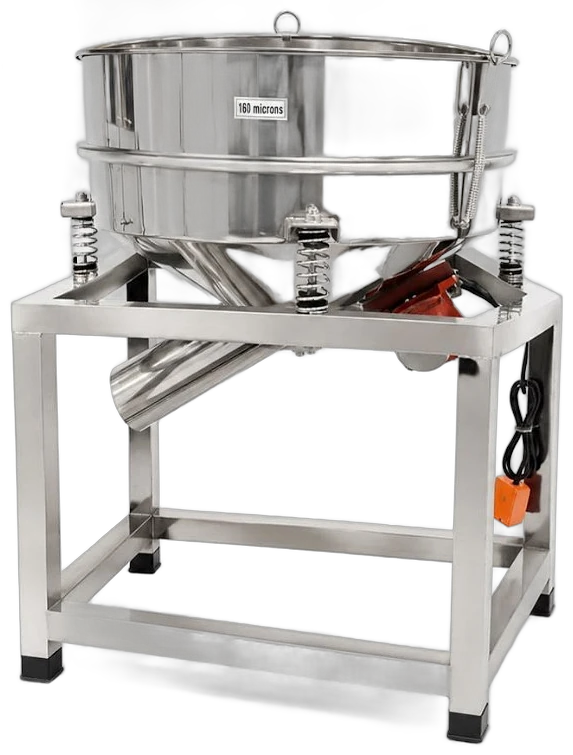
VibraHash S50 from the front, on the stainless steel frame with springs
of screen on the VibraHash S30 and S50
30 and 50 cm
in diameter on the 304 stainless tubes
2″ to 6″
in the vacuum chambers
18 and 34 L
on the Trim Box screen
150u

VibraHash line · vibratory sifting

  • Dry Sift
  • Dry Ice

The machine that turned sifting into a process.

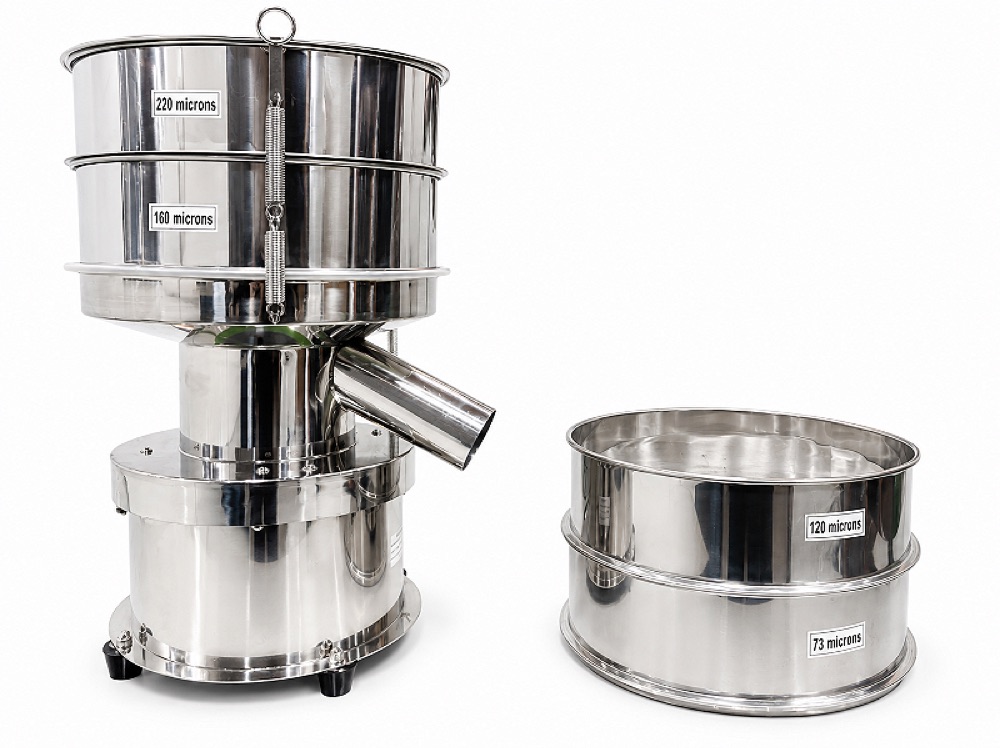
Stainless steel VibraHash S30 with the 220u and 160u screens mounted and the 120u and 73u screens stacked alongside1 / 3

Full set: two screens mounted and two alongside

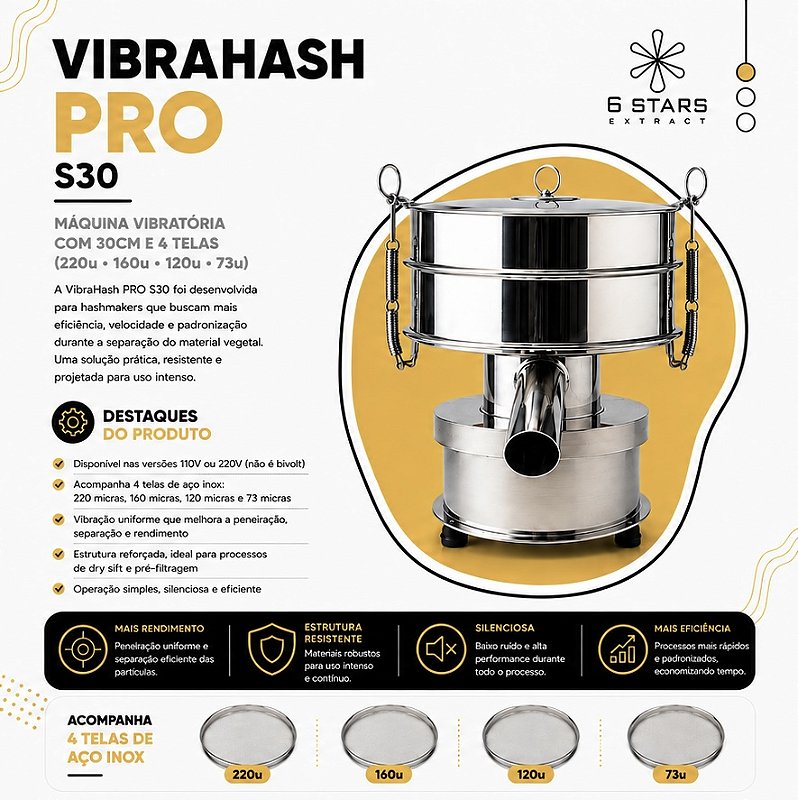
VibraHash S30 · 4 screens

In the store: VibraHash S30 - Acompanha 4 Telas

The complete S30: comes out of the box with all four stainless screens — 220u, 160u, 120u, and 73u — to sort the material by micron size.

Screens
4 · stainless
Diameter
30 cm
Power
110 V or 220 V

What's included

  • S30 vibrating sifter
  • 220u stainless screen
  • 160u stainless screen
  • 120u stainless screen
  • 73u stainless screen

What it is

The VibraHash is a stainless steel vibrating sifter. A motor makes the screen stack vibrate evenly: the material travels across the mesh, anything smaller than the micron size falls through, anything larger stays. No muscle, no rhythm that fades as you get tired, no “I tapped harder today.”

It's the same logic as a hand screen — just constant. The vibration is the same in the first minute and the last, which is why two batches done the same way come out comparable. That's what turns sifting into a process.

What problem it solves

  • Everyone sifts differently.

    The vibration comes from the machine, not the operator: the same intensity from the start of the batch to the end.

  • Sorting by micron size is a chore.

    On the 4-screen S30, the 220u, 160u, 120u, and 73u work stacked and sort the material in a single pass.

  • Large volumes are tiring and slow.

    The S50 takes the same logic to a 50 cm pan, built for large volumes of material.

How to use it

Step by step, from start to cleanup.

Six steps, from plugging it in to putting the screen away. Same for the S30 and the S50 — what changes is the batch size, not the method.

  1. Check the voltage and set it on a solid bench

    The VibraHash ships in 110 V or 220 V — it's not dual voltage, and you choose the version when you buy. Set it on a solid, level bench with the rubber feet sitting flat: vibration on a wobbly base turns into noise, not sifting.

  2. Stack the screens, coarsest to finest

    220u on top, then 160u, 120u, and the 73u last. Lock the stack with the side spring latches until there's no play. With a single screen, the principle is the same: screen, collector, latch.

  3. Load dry, cold material in a thin layer

    Very dry, ice-cold material releases the trichomes with fewer plant fragments coming along. Spread a thin layer over the top screen — a crowded screen sifts worse than one with room.

    With dry ice, wear gloves and work in a ventilated area.

  4. Turn it on and work in short passes

    The vibration does the work — no need to help with your hand. The first pass is the cleanest: the longer the material keeps vibrating, the more plant matter passes through with it. Two short passes, collected separately, beat one long one.

  5. Turn it off and collect fraction by fraction

    Release the latches and brush off what stayed on each screen and what dropped into the collector and the chute. Store and weigh each micron size separately: that's how you find out where your best material is.

  6. Clean it dry, store it dry

    A soft brush or a paintbrush right after use, before the resin sets into the mesh. If it's gummed up with resin, isopropyl alcohol, then let it dry completely. A screen put away dirty or damp loses its mesh — and the mesh is the machine.

The flow

The material's path through the four screens.

A screen stack is a sorter: each mesh catches what's larger than its opening and lets the rest through. What stays on each level is a size range — and you collect range by range.

The ranges come from the geometry of the screens included with the 4-screen S30. How much each range yields depends on the genetics and the material.

  1. Material

    Dry and cold, in a thin layer, on the top screen.

  2. 220u

    stays: above 220u

    Leaf, stem, and coarse plant fragments.

  3. 160u

    stays: 160u to 220u

    Fine plant fragments and the largest trichomes.

  4. 120u

    stays: 120u to 160u

    Large heads.

  5. 73u

    stays: 73u to 120u

    The most sought-after range: mature heads.

  6. Collector

    passes: below 73u

    The finest: small heads and dust, straight to the chute.

Specs

What the manufacturer specifies.

Power
110 V or 220 V (not dual voltage) — you choose the version when you buy
Screens
Stainless steel
Screen diameter
S30: 30 cm · S50: 50 cm
Screens included
S30 · 4 screens: 220u, 160u, 120u, and 73u · S30 · 1 screen: 160u · S50: 160u
Recommended for
Dry sift and pre-filtering
Frame
Reinforced, built for heavy use
Operation
“Simple, quiet, and efficient,” in the manufacturer's words
Replacement screens (S30)
220u, 120u, and 73u — sold individually or as a kit of 3

Source: Product description in the store · S30 screen kit description · S50 manufacturer's spec sheet · Manufacturer's spec sheet (1st product image) and labels in the photos.

Comparison

Single-screen S30, four-screen S30, or S50?

VibraHash S30 · 1 screen

R$ 2,590.00
Screen diameter
30 cm
Screens included
1 · 160u
Power
110 V or 220 V (not dual voltage)
Manufacturer's pitch
The budget option, for small batches and for anyone starting out
Extra screens in the catalog
3-screen kit (220u, 120u, 73u) and single screens

VibraHash S30 · 4 screens

R$ 3,590.00
Screen diameter
30 cm
Screens included
4 · 220u, 160u, 120u, and 73u
Power
110 V or 220 V (not dual voltage)
Manufacturer's pitch
Efficient, fast, and standardized separation
Extra screens in the catalog
Single replacement screen

VibraHash S50

R$ 6,990.00
Screen diameter
50 cm
Screens included
1 · 160u
Power
110 V or 220 V (not dual voltage)
Manufacturer's pitch
Larger scale than the S30, for large volumes
Extra screens in the catalog
Talk to 6 Stars

Still have questions about the VibraHash?

The people answering are the people who build it. Message us before you buy — or after, when it's time to set it up.

Pressurized BHO extractors

  • BHO

A volatile solvent calls for equipment that's up to the job.

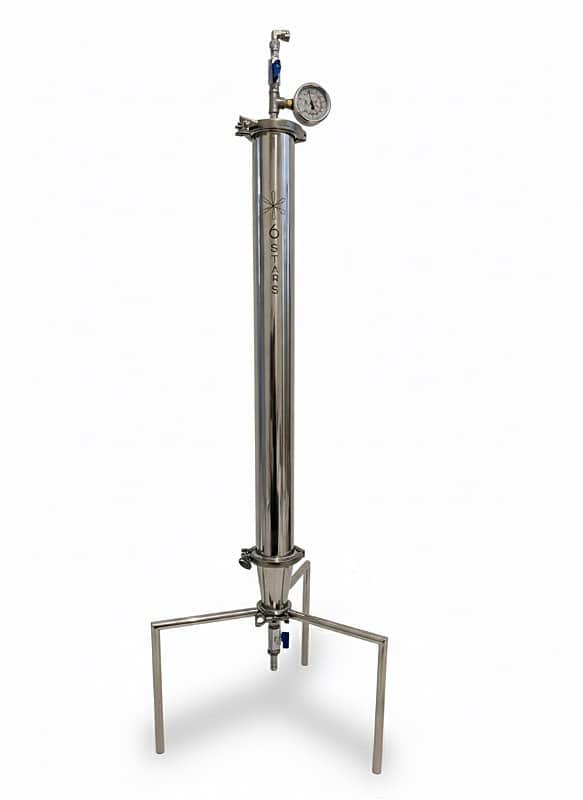
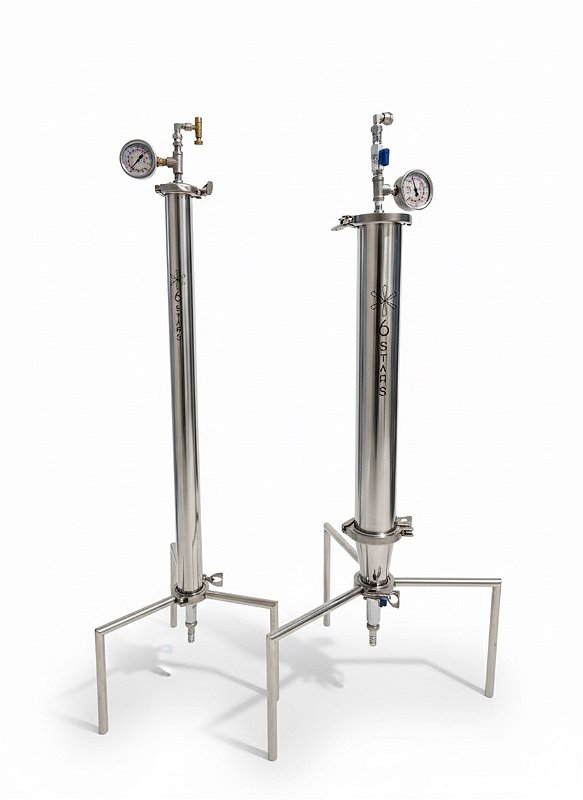
304 stainless steel extraction tube mounted on the tripod, with a ball valve and pressure gauge on top and an outlet valve at the base1 / 3

Mounted on the tripod: valve and pressure gauge on top, outlet valve at the base

Pressurized tube

In the store: Tubo de Extração BHO Pressurizado em Aço Inox

Direct extraction, no thermal control: the choice for anyone after practicality and value, in diameters from 2″ to 6″.

Material
Mirror-finish 304 stainless
Diameters
2″ · 3″ · 4″ · 6″
Connection
Tri-Clamp

What's included

  • Mirror-finish 304 stainless column
  • Tri-Clamp fittings

Exactly what comes in the set (valves, gauge, tripod) depends on the size: confirm in the store or on WhatsApp.

What it is

The 6 Stars extraction tubes are 304 stainless steel columns with a mirror finish, closed with Tri-Clamp fittings — the sanitary standard for a tight seal and quick assembly. The material goes in the column, the solvent passes through under pressure, and the gauge on top shows what's happening inside.

The line is modular: the tubes connect to one another, take our sight glass, screens, and gaskets, and drop into a Closed Loop system using the same parts. Start with one tube and the setup grows with your operation. Designed, machined, welded, and polished in Brazil.
What problem it solves

  • Time to move on from the open column.

    A closed 304 stainless column with valves, a pressure gauge, and Tri-Clamp fittings: resists corrosion, pressure, and solvents.

  • Waxes and lipids in the extract.

    The DEWAX chills the column from the outside: waxes and fats solidify and stay behind during the extraction itself.

  • Worried you'll buy now and have to replace everything later.

    Interconnecting tubes, from 2″ to 6″: you can add columns or integrate into a Closed Loop without swapping components.

How to use it

Step by step, from start to cleanup.

Seven steps — and the first one involves no equipment at all. This is an overview of running a pressurized tube; the DEWAX adds the cold step.

  1. The space comes before the equipment

    An open or very well-ventilated area. No flame, spark, cigarette, switch, motor, or running appliance nearby: butane vapor is heavier than air, pools at floor level, and can ignite far from where it leaked. Extinguisher at hand, goggles and gloves, and no one hanging around who doesn't need to be.

  2. Inspect before you assemble

    Gaskets that aren't cut or dried out, a clean screen, Tri-Clamps with clean, lubricated threads, gauge in place. If you have doubts about a part, it doesn't go into service — a gasket is a replacement part, not a keepsake.

  3. Load the column

    Dry material, evenly distributed, within what the capacity table allows for your tube — pack the column too tight and the solvent channels. Screen and gasket close the ends; the tube goes on the tripod, steady and upright.

  4. On the DEWAX, chill the jacket

    Fill the gap between the column and the outer jacket with dry ice or chilled alcohol and wait for the column to get cold. The cold is what makes waxes and fats solidify before they pass through with the solvent.

    Dry ice burns skin: gloves, always.

  5. Run the solvent with an eye on the gauge

    Tight fittings, valves in order, and the needle always within the equipment's working range. The sight glass, when installed, shows the flow and flags a blockage or a bubble.

    Smell of gas or a hiss: stop, close the valves, and ventilate before anything else.

  6. Collect and take it to the purge

    The extract comes out through the bottom valve — into the collection vessel or, in a Closed Loop, into the rest of the system, where the solvent is recovered. What's left of the solvent comes off in the purge, in a vacuum chamber: never with an open flame, never in an enclosed space.

  7. Disassemble, clean, and inspect again

    Only disassemble with the system depressurized and the space ventilated. Screens wiped down with isopropyl alcohol and stored dry; clamps clean, threads lubricated; gaskets checked one by one. The next run starts with cleaning this one.

This walkthrough is an overview and doesn't replace training. If in doubt about assembly, compatibility, or procedure, talk to 6 Stars before you run it.

Capacity

Sizes and capacities.

Six column sizes, from test runs to professional batches. How much material fits depends on how tightly it's packed — the manufacturer publishes both ends of the range.

Sizes and capacities: usable volume and material capacity, in grams, by column size
ColumnVol.Material (g)
MediumPacked
2″ × 30 cm0.54 L90135
2″ × 78 cm1.4 L240350
3″ × 50 cm2.11 L350480
3″ × 78 cm3.29 L550750
4″ × 90 cm6.92 L1,3801,730
6″ × 80 cm14.05 L2,8103,510

Approximate values, calculated by the manufacturer with average densities; they vary with the type of material and how tightly it's packed.

Specs

What the manufacturer specifies.

Material
304 stainless steel, mirror finish
Diameters
2″, 3″, 4″, and 6″
Connections
Tri-Clamp standard
Usable volume
From 0.54 L to 14.05 L, in six sizes
Modularity
Interconnecting tubes; direct Closed Loop integration; upgrades without swapping components
DEWAX
External cooling jacket, for dry ice or chilled alcohol
Use
Standalone or integrated into a Closed Loop system
Manufacturing
100% made in Brazil — designed, machined, welded, and polished by hand

Source: Product description in the store.

Comparison

Pressurized tube or DEWAX?

Pressurized tube

from R$ 2,790.00
Thermal control
Direct extraction, no thermal control
Waxes and lipids
Not retained in the column
Recommended for
Practicality and value
Material
304 stainless steel
Connection
Tri-Clamp · Closed Loop compatible
Sizes
Six capacities · 0.54 L to 14.05 L

DEWAX tube

from R$ 3,490.00
Thermal control
Outer jacket chilled with dry ice or chilled alcohol
Waxes and lipids
Retained during the extraction itself (inline winterization)
Recommended for
Clarity and purity
Material
304 stainless steel
Connection
Tri-Clamp · Closed Loop compatible
Sizes
Six capacities · 0.54 L to 14.05 L

Both tubes are priced by capacity: you pick the option on the product page, in the store.

Still have questions about the extractors?

The people answering are the people who build it. Message us before you buy — or after, when it's time to set it up.

The process continues in the next chapter: vacuum chambers for the purge →

Vacuum chambers · purge

  • BHO

Where the extract becomes a finished product.

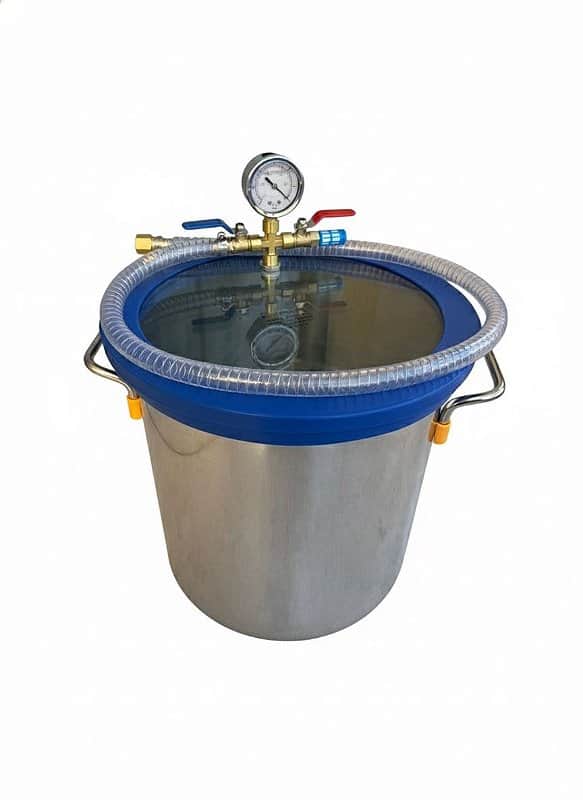
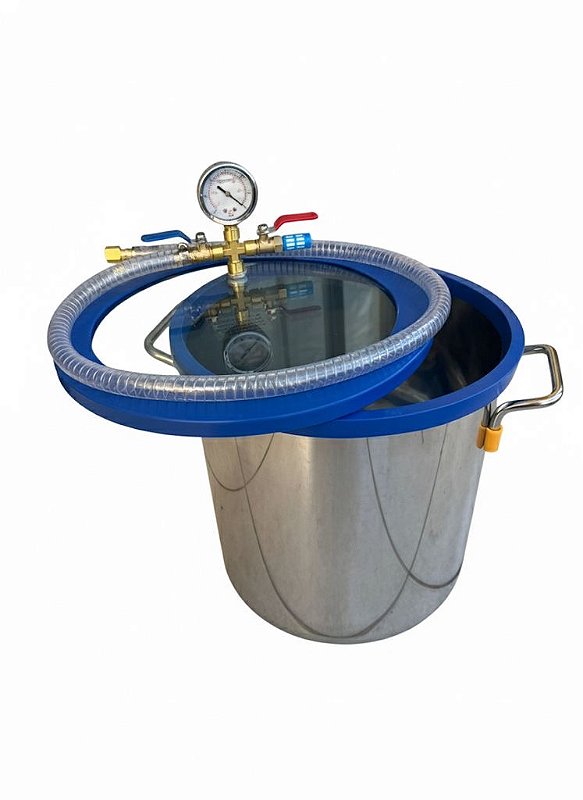
Closed stainless steel vacuum chamber, with acrylic lid, blue gasket, compound gauge, two ball valves, and hose1 / 4

Closed: acrylic lid, compound gauge, and the two valves

Vacuum chamber 18 liters

In the store: Câmara de Vácuo 18 Litros

Eighteen liters of capacity, with the same build as its bigger sibling: stainless pot, acrylic lid, and ball valve.

Capacity
18 L
Lid
Acrylic
Recommended pump
2 to 12 CFM

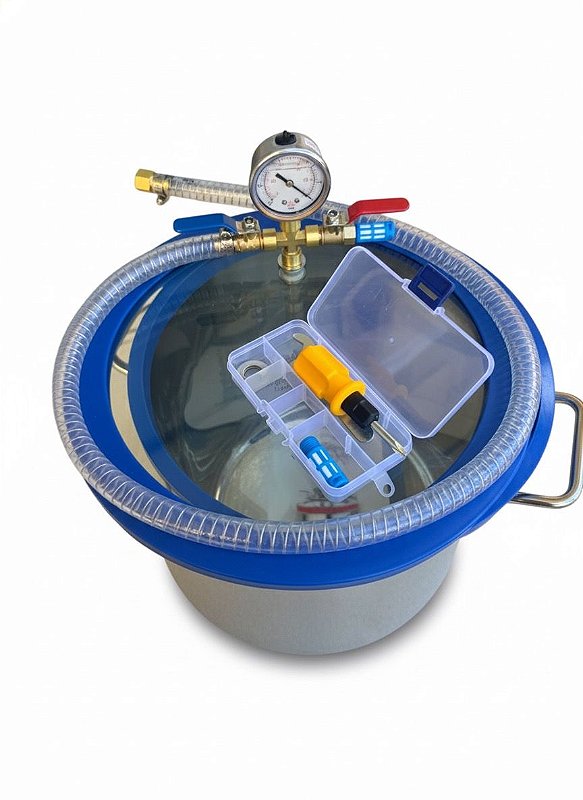
What's included

  • Stainless steel pot
  • Acrylic lid with compound gauge and valves
  • Vacuum pump: sold separately

What it is

After extraction, the extract still carries residual solvent. The vacuum chamber is the step that pulls out what's left: a stainless steel pot sealed with an acrylic lid and hooked up to a pump. With the pressure way down, the solvent evaporates out of the extract and gets drawn off.

The clear lid isn't a detail: a purge is something you watch. The ball valve holds the vacuum, the compound gauge shows whether it's holding — and every chamber has its seal tested for 24 hours before it leaves 6 Stars.

What problem it solves

  • Residual solvent in the extract.

    Purge under vacuum: the manufacturer recommends at least 24 hours for a full purge, and it can run past 48.

  • Purging blind.

    Clear acrylic lid: the extract stays in view the whole time.

  • Vacuum that won't hold.

    Seal pre-tested for 24 hours and a ball valve on the lid.

How to use it

Step by step, from start to cleanup.

Six steps. Three variables decide the purge — vacuum, temperature, and time — and the chamber is there so you can control the first and watch the result.

  1. Connect the pump to the chamber

    The chamber doesn't come with a pump: the manufacturer recommends a 2 to 12 CFM vacuum pump. Connect the hose to the valve on the lid and check that the fittings are tight.

  2. Pick the spot

    The pump exhaust carries solvent vapor. A ventilated area, away from flames, sparks, and any ignition source — the BHO rule still applies to the purge.

  3. Lay the extract out in a thin layer

    On a nonstick surface, in the center of the pot. A thin layer purges evenly; a thick one holds solvent in the middle.

  4. Close it and pull vacuum gradually

    Lid centered on the gasket, pump on, valve opened slowly. The extract expands as the pressure drops: watch it through the lid and throttle the valve so it doesn't boil over. The compound gauge shows when you've reached vacuum.

  5. Hold the vacuum and give it time

    Close the ball valve and let the purge work. Manufacturer's recommendation: at least 24 hours for a full purge, and it can run past 48. If the needle drops, pull vacuum again.

  6. Release slowly, collect, and clean

    Open the relief valve a little at a time before lifting the lid — releasing the vacuum all at once splatters the extract. Collect, clean the pot and the gasket, and store the chamber dry.

Specs

What the manufacturer specifies.

Capacity
18 L or 34 L
Body
Stainless steel pot
Lid
Clear acrylic
Valve
Ball valve
Seal
Pre-tested for 24 hours
Vacuum pump
Not included · recommended: 2 to 12 CFM
Recommended purge time
24 h minimum, and it can run past 48 h

Source: Product description in the store.

Comparison

18 or 34 liters?

Vacuum chamber 18 liters

R$ 1,999.90
Capacity
18 L
Build
Stainless pot · acrylic lid · ball valve
Recommended pump
2 to 12 CFM · not included

Vacuum chamber 34 liters

R$ 2,890.00
Capacity
34 L
Build
Stainless pot · acrylic lid · ball valve
Recommended pump
2 to 12 CFM · not included

The only difference between the two is capacity: the rest of the manufacturer's spec is the same.

Accessories and parts

Replacement parts.

The instrument that tells you whether the vacuum is holding.

The vacuum pump is sold separately (manufacturer's recommendation: 2 to 12 CFM). Not sure which pump? Message 6 Stars.

Still have questions about the chambers?

The people answering are the people who build it. Message us before you buy — or after, when it's time to set it up.

Trim Box · trimming and manual dry sift

  • Dry Sift
  • Dry Ice

The whole bench in one tray.

1 / 2

The double tray: 150u screen on top, collection tray underneath

Trim Box

In the store: Trim Box

Double tray with a 150u screen, removable collection tray, and the accessories for trimming, taking a close look, and collecting.

Screen
150u
Screen area
38 × 20 cm
Total area
47 × 30 cm

What's included

  • Tray with 150u screen
  • Removable collection tray
  • Trim Cutter
  • Zoom Card
  • Brush
  • Sift Card

The product description in the store lists four accessories (Trim Cutter, Zoom Card, brush, and Sift Card); the manufacturer's artwork highlights three. If in doubt, confirm on WhatsApp before you buy.

What it is

The Trim Box is a double tray: on top, a 150u steel screen with 38 × 20 cm of usable area; underneath, the removable collection tray. You trim the material over the screen and, in the same motion, whatever shakes loose falls through the mesh and collects in the tray below.

It's the entry point to manual dry sift — and the most direct way to understand the process: everything happens in front of you, at the speed of your own hands. It comes with the accessories for trimming, taking a close look, and collecting.

What problem it solves

  • Trimming on one table, sifting on another.

    Multipurpose double tray: trim, separate, and collect in one unit.

  • What falls during trimming gets lost.

    The 150u screen sits under the material the whole time: whatever comes loose lands in the collection tray, already sifted.

  • Getting started without investing in a machine.

    Screen, collection tray, and the accessory kit in one box.

How to use it

Step by step, from start to cleanup.

Six steps — the manufacturer's own, in the order they're given.

  1. Set the dry material on the tray

    Dry material, placed on the top tray — the one with the screen.

  2. Trim with the Trim Cutter

    Remove leaves and excess right there: whatever comes loose as you cut lands on the screen.

  3. Spread and move it gently

    Spread the flower and trim over the screen and work it with light movements until the material falls through the mesh and settles in the lower tray.

  4. Give the screen a few light taps

    Short taps clear the steel mesh and free whatever's stuck.

  5. Collect with the brush and the Sift Card

    Separate the trays and collect what ended up in the collection tray — that's the manufacturer's recommendation. The Zoom Card is for taking a close look at what you collected.

  6. Store it for the cure — and clean the box

    The manufacturer recommends a glass jar or a slick to start the cure. Clean and dry the Trim Box after every use: that's what keeps the mesh accurate.

Specs

What the manufacturer specifies.

Total area
47 cm × 30 cm
Screen area
38 cm × 20 cm
Micron size
150u
Screen
Stainless steel
Trays
Reinforced plastic · removable collection tray
Included accessories
Trim Cutter, Zoom Card, brush, and Sift Card
Packaging
With accessories and a basic manual

Source: Product description in the store · Manufacturer's spec sheet (1st product image).

Accessories and parts

From the tray to the standalone screen.

When you outgrow the Trim Box, the next rung in manual dry sift are the standalone 304 stainless steel screens.

Still have questions about the Trim Box?

The people answering are the people who build it. Message us before you buy — or after, when it's time to set it up.

The machine standardizes the process. We choose the model together.

Voltage, batch size, what's included, what your setup is missing: message us before you buy.

Machines — VibraHash, BHO extractors, vacuum chambers, and Trim Box · 6 Stars Extract